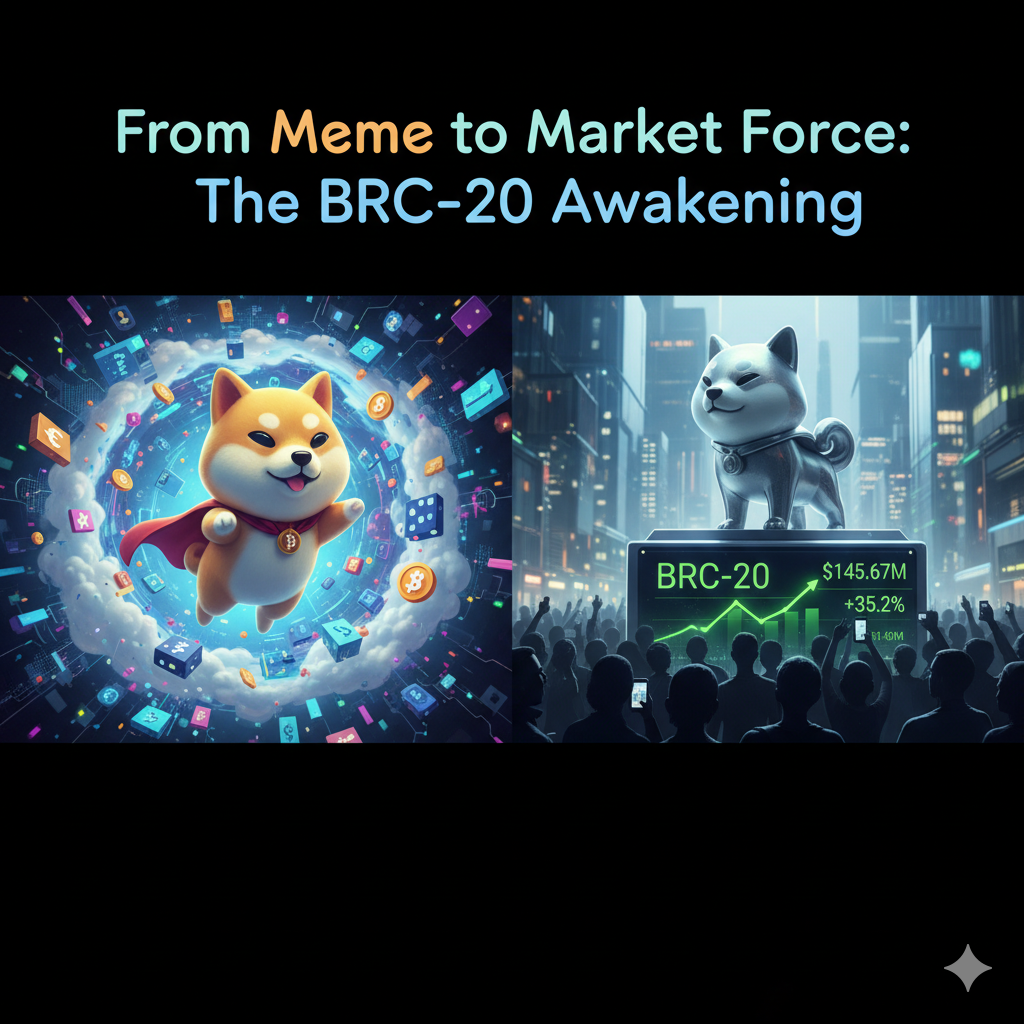
Not long ago, BRC-20 tokens were widely dismissed as little more than a passing joke—an experimental sideshow riding on the coattails of Bitcoin’s legacy. Today, that narrative is rapidly unraveling. With $1.43 billion in 24-hour trading volume, what was once mocked is now commanding attention—and capital—at scale.
At the heart of this shift lies a familiar yet powerful dynamic: scarcity. A fixed supply of 21 million has once again proven to be more than just a technical constraint—it’s a psychological trigger. Markets don’t merely respond to fundamentals; they react to belief. And right now, that belief is compounding. In this context, $ORDI is emerging as a compelling case study—a token with no pretense of utility, yet increasingly perceived as a pure store of value.
This is where the story becomes less about logic and more about structure. Strip away the noise, and three forces define the current moment:
- Verifiable on-chain originality
- A surge of fresh liquidity entering the system
- A community-driven viral loop unlike anything seen before in the Bitcoin ecosystem
Together, they form a feedback cycle that is both self-reinforcing and, at times, destabilizing.
Because in crypto, one principle remains undefeated: liquidity dictates reality. Capital flows shape narratives faster than narratives shape value. The cycle is as old as markets themselves—fear gives way to greed, greed to excess, and excess to liquidation.
Yet the underlying question persists: how sustainable is an asset with no clear utility?
Bitcoin itself offers a partial answer. Its value doesn’t stem from traditional cash flows or industrial use—it emerges from consensus. A decentralized network upheld by miners, secured by code, and believed in by millions. Its strength lies in being first, in being recognized, in being accepted.
So what happens when that same logic is applied downstream?
What is an asset worth when its only claim is origin—when its value is rooted not in function, but in narrative primacy?
In this cycle, the line between absurdity and inevitability is thinner than ever.