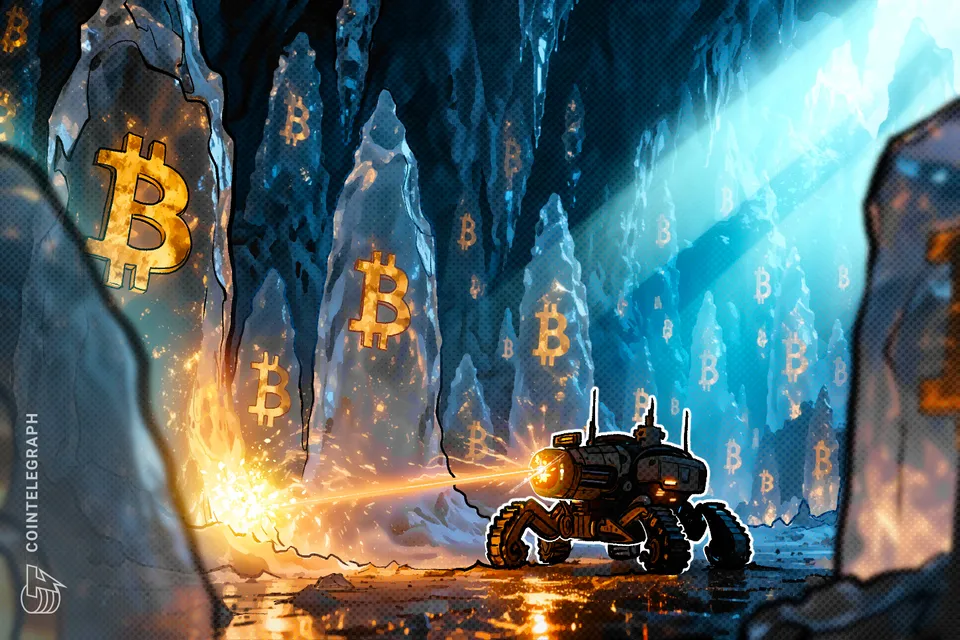
Bitcoin mining has long been viewed as a game dominated by billion-dollar companies operating massive warehouses filled with specialized hardware. But one hobby miner has just reminded the industry that luck still plays a role in Bitcoin’s proof-of-work network.
A solo miner successfully validated Bitcoin block 957382 using a single Bitaxe mining device—a compact machine costing less than $200—earning the full 3.125 BTC block reward worth approximately $200,000.
While the odds of such an event are extraordinarily low, the latest win highlights a reality that is often overlooked: Bitcoin mining remains one of the few industries where a retail participant can occasionally outperform industrial-scale competitors.
A Lottery Hidden Inside Bitcoin Mining
The Bitaxe miner operates at roughly 1 terahash per second (TH/s), an almost insignificant amount of computing power compared with Bitcoin’s global hashrate, which is measured in exahashes per second.
Under normal circumstances, such a device would be expected to mine for many years—or even centuries—before independently discovering a valid block.
Yet Bitcoin’s mining process is fundamentally probabilistic rather than deterministic. Every hash submitted has an equal chance of becoming the winning solution, regardless of whether it comes from a warehouse containing tens of thousands of ASICs or a single desktop-sized machine running in someone’s home.
In this sense, solo mining resembles purchasing lottery tickets, except each hash represents another chance to solve the cryptographic puzzle before anyone else.
Retail Miners Refuse to Disappear
The latest jackpot is not an isolated event.
This marks the 12th solo Bitcoin block mined by hobby miners in 2026, bringing total rewards distributed to retail participants over the past 12 months to more than 75 BTC, worth approximately $4.7 million.
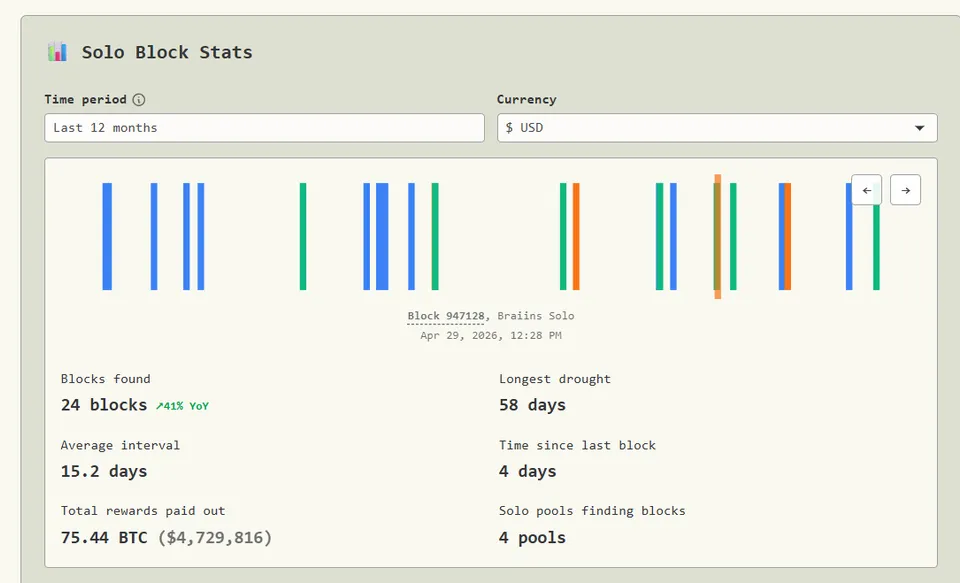
Even more notable, the number of solo blocks has increased 41% year-over-year, suggesting that hobby mining remains alive despite record network difficulty and growing institutional competition.
While industrial mining firms continue to control the overwhelming majority of Bitcoin’s hashrate, these occasional victories demonstrate that decentralization is still functioning as intended.
More Than Profit—It’s About Participation
For many hobby miners, profitability is no longer the primary objective.
Instead, small-scale mining has increasingly become a way to directly participate in securing the Bitcoin network. Open-source devices such as the Bitaxe have gained popularity because they lower the barrier to entry, allowing enthusiasts to contribute hashrate without investing thousands of dollars in industrial-grade equipment.
The rare possibility of earning a full block reward has become an added incentive rather than the sole motivation.
A Reminder of Bitcoin’s Core Philosophy
Perhaps the most important takeaway is symbolic rather than financial.
As Bitcoin mining becomes increasingly dominated by publicly listed companies and large mining pools, stories like this reinforce one of Bitcoin’s founding principles: permissionless participation.
Anyone, regardless of capital, can connect a mining device to the network and compete under exactly the same protocol rules as the largest mining corporations.
The probability may be microscopic, but the opportunity remains open to everyone.
Market Outlook
The latest solo mining success is unlikely to alter Bitcoin’s mining economics or challenge the dominance of industrial operators. However, it serves as a powerful reminder that Bitcoin’s proof-of-work system continues to preserve equal opportunity at the protocol level.
For retail participants, the odds remain exceptionally slim, and solo mining should not be viewed as a reliable investment strategy. Yet as open-source mining hardware becomes more accessible, hobby miners continue to demonstrate that Bitcoin’s decentralized ethos is more than just a slogan—it is still embedded in the network’s design.