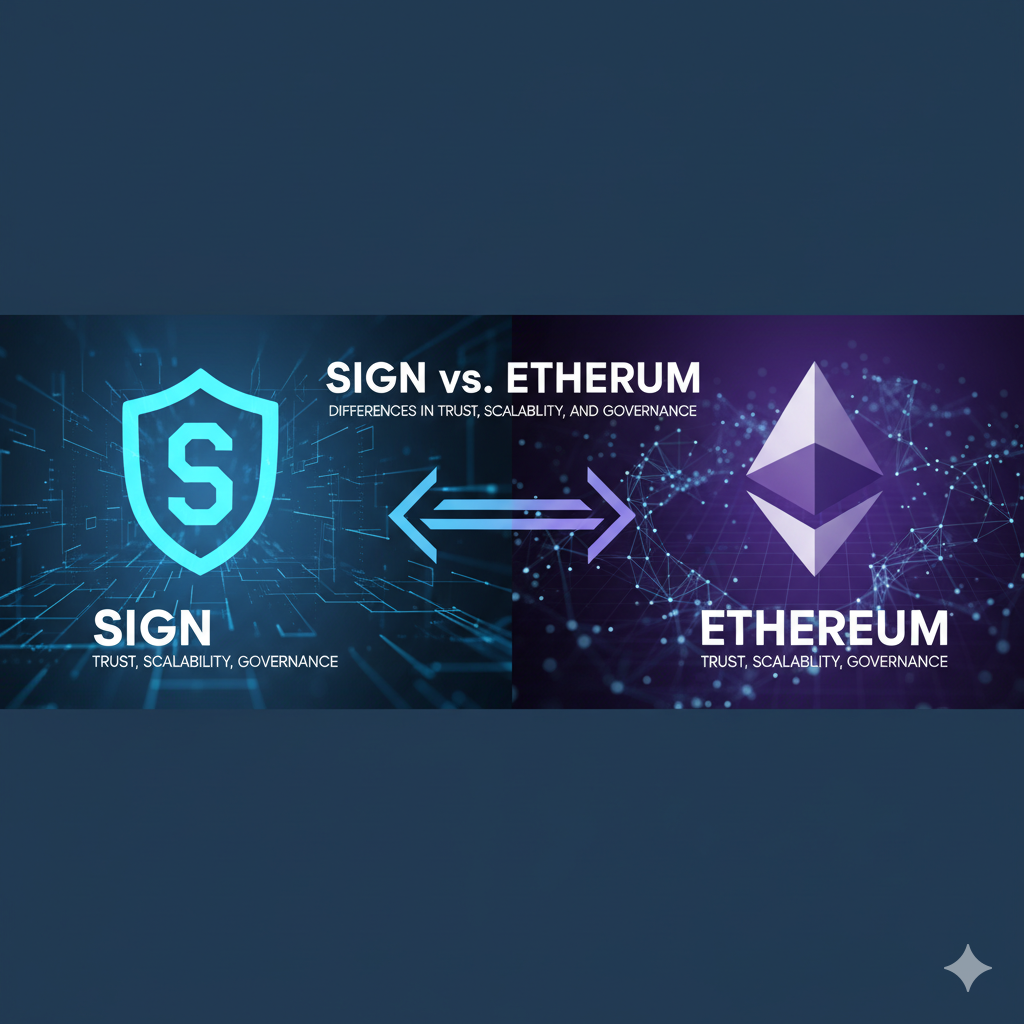
Beyond Coins and Charts: The Battle for Trust Infrastructure in Web3
Scroll through crypto headlines and you’ll see the usual noise—price swings, token launches, market speculation. But beneath that surface lies a deeper question that’s starting to define the next phase of the industry:
What kind of trust are these networks actually building?
That’s where the contrast between Ethereum and SIGN becomes more than just technical—it becomes philosophical.
Ethereum: The Metropolis of Decentralization
Ethereum didn’t just expand crypto—it redefined it. By introducing smart contracts, it transformed blockchains from simple payment rails into programmable infrastructure.
From DeFi to NFTs, entire digital economies now run on Ethereum. Its strength lies in its generality: a permissionless, flexible foundation where developers can build almost anything.
But that power comes with tradeoffs.
Ethereum today feels like a sprawling digital metropolis—alive with innovation, yet often congested. High fees, layered scaling solutions, and fragmented user experiences reflect a system that has grown rapidly, sometimes faster than it can simplify itself.
It remains foundational—but not always frictionless.
SIGN: Engineering Trust as a Primitive
SIGN approaches the problem from a different axis entirely.
Instead of asking, “What can we build on-chain?” it asks:
“How should trust itself exist on-chain?”
This is a subtle but powerful shift.
In the real world, trust is constantly being verified—identity, credentials, approvals, ownership. Yet most of this data is siloed, repetitive, and inefficient. Users are forced to resubmit the same proofs across platforms, often exposing more personal information than necessary.
SIGN’s thesis is simple:
Trust should be portable, structured, and verifiable—without unnecessary exposure.
Rather than serving as a general-purpose computation layer, SIGN positions itself as a trust infrastructure layer—where attestations, credentials, and proofs can live, move, and be reused across systems.
Two Visions, Two Value Propositions
The distinction becomes clear:
- Ethereum provides the tools to build trust-based systems
- SIGN aims to become the layer where trust itself is stored and transmitted
Ethereum is about possibility.
SIGN is about verification.
That difference reshapes their long-term value.
In a world increasingly driven by digital identity, compliance, and coordination, reusable trust primitives could become just as critical as smart contracts themselves.
Rethinking Scalability
Scalability is often framed in terms of speed and cost—but here, the definition diverges.
Ethereum has made major strides through Layer 2s and rollups, expanding throughput while maintaining decentralization. But this evolution introduces complexity: assets move across layers, liquidity fragments, and users must navigate an increasingly modular stack.
SIGN, by contrast, reframes scalability:
It’s not just about how many transactions a network can process—
It’s about how efficiently trust can propagate across systems.
If users and institutions can verify once and reuse infinitely, the entire digital experience becomes lighter, faster, and less invasive.
That’s a different kind of scale—and arguably a more human one.
Governance and the Shape of Trust
Governance further highlights the divide.
Ethereum’s governance is broad and decentralized, shaped by developers, validators, and community consensus. It’s powerful—but often abstract and difficult for everyday users to track.
SIGN’s governance, however, is inherently tied to its mission.
If the protocol defines how attestations and credentials work, then governance becomes a question of:
- What standards of trust are accepted
- How identity and verification evolve
- Whether the system remains ethical, scalable, and usable
It’s governance not just of a network—but of digital trust itself.
The Bigger Signal
None of this diminishes Ethereum’s role. It remains one of the most important pillars in crypto—and likely will for years to come.
But SIGN stands out because it narrows its focus to something foundational:
Organizing trust in an increasingly digital world.
As Web3 matures, the question may no longer be just about decentralization or programmability—but about verifiability at scale.
If that shift plays out, SIGN won’t simply ride the next wave of crypto innovation.
It may help define what that wave looks like.