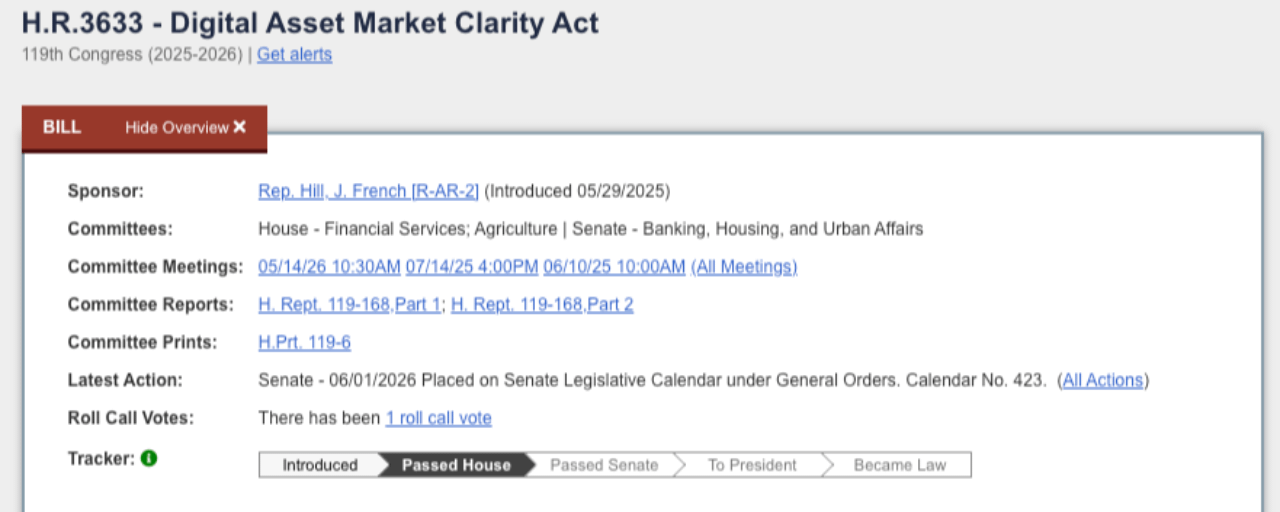
The U.S. Senate has officially added the Digital Asset Market Clarity Act, commonly known as the CLARITY Act, to its legislative agenda, signaling continued momentum toward establishing a comprehensive regulatory framework for the cryptocurrency industry.
According to reports from Foresight News, the development was confirmed through the official legislative tracking platform of the U.S. Congress, placing the long-anticipated bill on the Senate’s roadmap for consideration.
The CLARITY Act is widely viewed as one of the most significant crypto-related legislative proposals currently under discussion in Washington. The bill seeks to provide clearer regulatory definitions for digital assets and establish jurisdictional boundaries among federal agencies overseeing the rapidly evolving crypto sector.
Industry participants have long argued that regulatory uncertainty has hindered innovation and institutional adoption in the United States. Supporters of the legislation believe the CLARITY Act could help address these concerns by creating a more predictable compliance environment for crypto exchanges, blockchain developers, token issuers, and investors.
The bill’s addition to the Senate agenda does not guarantee immediate passage, but it represents an important procedural milestone as lawmakers continue debating the future of digital asset regulation. Market observers will be closely monitoring the next stages of the legislative process, including committee discussions, amendments, and potential Senate votes.
The move comes amid growing efforts by U.S. policymakers to establish clearer rules for the digital asset industry, as regulators and lawmakers face increasing pressure to balance investor protection with technological innovation.
For the crypto market, the advancement of the CLARITY Act could prove to be a pivotal development, potentially laying the groundwork for a more structured and institution-friendly regulatory landscape in the world’s largest economy.