
For years, crypto investors have relied on a familiar market cycle. Bitcoin would rally first, profits would gradually flow into Ethereum, and eventually even smaller altcoins would experience explosive gains. That pattern helped define every major bull market over the past decade.
But the next cycle could look very different.
New market data suggests that the broad-based altcoin season many investors are waiting for may no longer exist. Instead of capital spreading across thousands of cryptocurrencies, institutional investors are increasingly concentrating their money into a relatively small group of established digital assets.
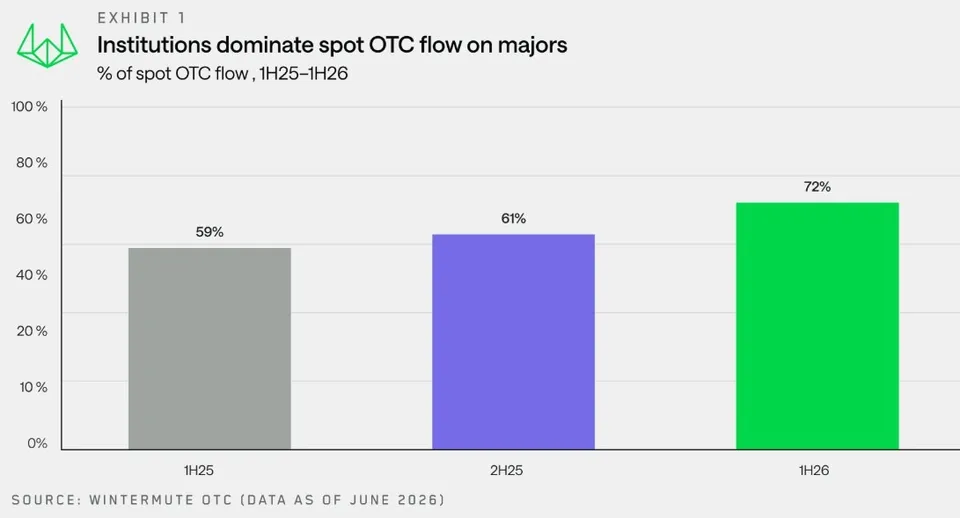
According to crypto market maker Wintermute, institutional clients generated 72% of spot trading volume on its OTC desk during the first half of 2026—the highest share the company has ever recorded. More importantly, those investors showed little interest in expanding into the growing universe of smaller cryptocurrencies.
Over the past two years, the number of unique tokens traded by institutional counterparties increased by just 24%, while retail traders expanded into 76% more assets. The contrast highlights a fundamental difference in investment behavior. Institutions are becoming increasingly selective, while retail investors continue searching for the next breakout token.
That shift could permanently reshape how crypto bull markets unfold.
Historically, strong Bitcoin rallies created enough liquidity for speculative capital to spread throughout the market. Today, that rotation appears much weaker. CryptoQuant CEO Ki Young Ju recently argued that the classic cycle of Bitcoin profits flowing into smaller cryptocurrencies has “basically disappeared,” with trading activity in Bitcoin-denominated altcoin pairs falling to levels not seen since 2021.
The market itself reflects that concentration. The ten largest non-stablecoin altcoins now account for more than 80% of the total market capitalization outside Bitcoin and stablecoins. Rather than broad participation, investors are increasingly directing capital toward projects with deep liquidity, strong ecosystems, and institutional credibility.
Exchange data tells the same story. Analytics firm Kaiko found that the ten largest altcoins represented 63% of all altcoin trading volume, a significant increase from previous years. As liquidity concentrates, smaller projects face greater challenges attracting sustained investor interest.
Industry participants believe the growing number of crypto projects is partly responsible. Thousands of tokens are now competing for attention, while institutional investors remain focused on assets with proven track records, including Bitcoin, Ether, and tokenized real-world assets.
This doesn’t necessarily mean altcoins are finished. Instead, future rallies may become increasingly driven by individual sectors, technologies, or narratives rather than lifting nearly every token simultaneously. Artificial intelligence, decentralized finance, gaming, or tokenized assets could each experience their own mini bull markets without triggering a market-wide altcoin explosion.
For investors, the message is becoming increasingly clear. Success may depend less on simply owning a diversified basket of altcoins and more on identifying the relatively small number of projects capable of attracting institutional capital. As the crypto market matures, selectivity—not speculation—may become the defining characteristic of the next bull cycle.