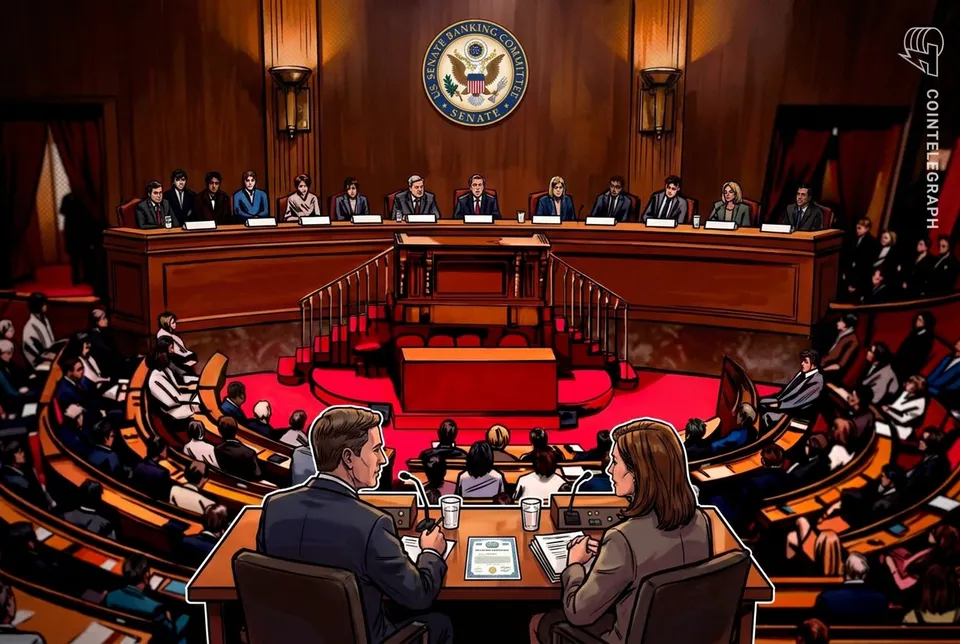
Two candidates nominated by President Donald Trump to fill vacant positions at the US Securities and Exchange Commission (SEC) faced questions from lawmakers during a Senate confirmation hearing on Thursday. Discussions focused on the balance between investor protection, regulatory transparency, and the development of financial technologies, particularly the growing market for tokenized securities.
The nominees, former Commodity Futures Trading Commission (CFTC) Commissioner Kristin Johnson and former SEC staff member Steven Levine, presented different perspectives on how the regulator should approach emerging financial products and its existing regulatory framework.
Johnson, who was nominated as a Democrat, expressed support for a formal rulemaking process to examine concerns surrounding the SEC’s recent exemption for platforms trading tokenized versions of publicly listed stocks.
Responding to Democratic Senator Angela Alsobrooks, Johnson emphasized the importance of public participation in regulatory decisions. She argued that allowing stakeholders to review proposed changes and submit feedback through a notice-and-comment process would help strengthen regulatory outcomes. She also indicated her willingness to revisit the issues associated with the exemption if confirmed.
The SEC introduced the exemption on September 17, allowing eligible trading platforms to facilitate transactions involving blockchain-based representations of US-listed equities without registering as traditional securities exchanges, provided they satisfy certain conditions. The measure became effective immediately, while the regulator opened a public consultation on potential adjustments.
Levine, who previously worked as an aide to SEC Commissioner Mark Uyeda, offered a more cautious response. He acknowledged that he had not examined the exemption in detail but understood that it was temporary and included safeguards for investors. He also defended the SEC’s authority to grant exemptions from federal securities requirements when such decisions serve the public interest and remain consistent with investor protection.
To support his position, Levine referred to the development of exchange-traded funds (ETFs), noting that regulatory exemptions had helped facilitate financial innovation before broader regulatory frameworks were established.
If both candidates receive Senate approval, the SEC would have four sitting commissioners, comprising three Republicans and one Democrat. Johnson would therefore become the agency’s sole Democratic commissioner.
Tokenized Stock Trading Faces Resistance From Public Companies
The SEC’s innovation exemption has generated considerable debate among market participants, particularly publicly traded companies concerned about the representation and distribution of their shares through blockchain-based platforms.
According to a public notice dated November 5, a total of 67 companies objected to the tokenization of their shares on the OKXICE platform. Their opposition reflects broader questions about shareholder rights, corporate authorization, market transparency, and the regulatory responsibilities of platforms offering tokenized equities.
Johnson also highlighted potential weaknesses in Anti-Money Laundering (AML) and Know Your Customer (KYC) compliance. Her comments suggested that the concerns surrounding tokenized stock trading extend beyond traditional securities regulation and include broader financial compliance requirements.
The debate comes at a time when the SEC has reduced certain cryptocurrency-related enforcement activities while exploring regulatory approaches intended to accommodate digital assets. However, its efforts to facilitate tokenized securities have attracted increasing attention from both lawmakers and traditional market participants.
Bipartisan Representation Could Shape the SEC’s Regulatory Direction
The confirmation process also carries broader implications for the political balance and future policy direction of the SEC.
Some representatives of the cryptocurrency industry believe that maintaining bipartisan participation within the commission is important for developing regulations that can withstand political changes and gain wider institutional support.
Jessica Martinez, US policy director at digital asset infrastructure firm Fireblocks, argued that cryptocurrency regulation should not be treated as a partisan issue. In her view, regulatory frameworks developed through bipartisan cooperation are more likely to provide long-term stability and credibility.
She also emphasized that commissioners representing the political minority can still play an influential role by questioning proposed policies, identifying regulatory gaps, and encouraging further discussion before final decisions are made.
Following Thursday’s hearing, senators were given until noon on Friday to submit additional written questions to the nominees. Their responses are expected by 5:00 pm Eastern Time on November 24, according to the committee’s closing remarks.
The nominations may subsequently proceed to a committee vote before reaching the full Senate. Johnson and Levine must both secure Senate confirmation before officially joining the SEC.
Ultimately, the outcome of these appointments could influence how the SEC approaches the intersection of traditional financial markets and blockchain technology, particularly as tokenized securities continue to challenge existing regulatory structures.