
Bitcoin is beginning to attract fresh capital across multiple market segments, but investors remain unconvinced that the recent recovery marks the start of a sustained uptrend.
While spot buyers, futures traders and ETF investors all returned during the week, broader market sentiment continues to reflect caution, highlighting the disconnect between actual capital flows and investor psychology.
Buyers quietly step back into the market
Onchain and derivatives data showed meaningful buying interest returning after Bitcoin’s recent weakness.
The cumulative volume delta across spot and futures markets recorded a net $925 million of buying on Wednesday, enough to absorb the entire post-US CPI pullback without triggering another wave of selling. At the same time, US spot Bitcoin ETFs extended their recovery with $107.7 million in net inflows, following another $181 million added a day earlier.
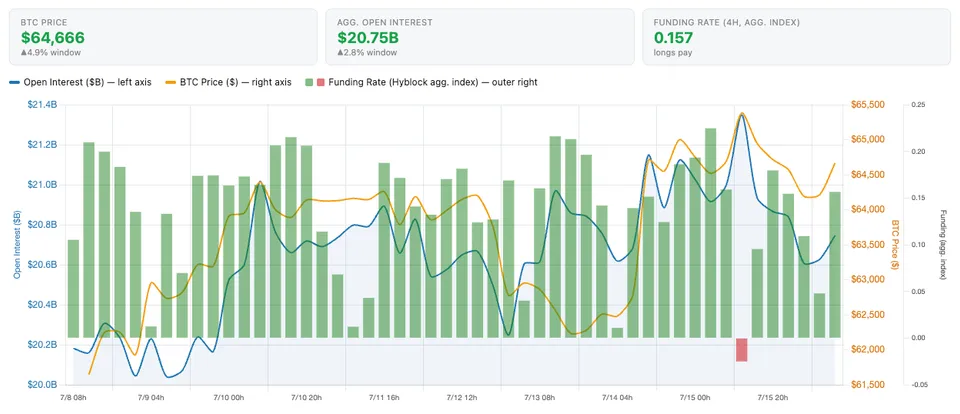
The combination suggests institutional and spot demand is gradually reappearing, even as Bitcoin trades near the upper end of its recent range.
Leverage also became healthier during the week. Funding rates cooled from as high as 0.22% to around 0.048%, while open interest declined 3.4% without causing a significant price correction. Instead of signaling panic, the move points to traders reducing exposure after Bitcoin approached resistance between $65,000 and $66,000.
Sentiment tells a very different story
Despite improving market structure, investors remain reluctant to embrace a bullish narrative.
The Crypto Fear & Greed Index continues to hover around 26, firmly inside “Fear” territory, even after Bitcoin rebounded roughly 4.4% from its recent low near $62,100.
Historically, this type of divergence has often worked in favor of bulls. Recoveries that develop while sentiment remains pessimistic have generally proven more sustainable than rallies fueled by widespread optimism.
However, the lack of confidence also reflects growing macroeconomic uncertainty rather than simple market skepticism.
Macro risks continue to cap optimism
Geopolitical tensions and monetary policy remain significant headwinds for Bitcoin.
The renewed conflict involving the United States and Iran pushed oil prices above $85 per barrel during the week, while market expectations continue to assign more than a 44% probability that the Federal Reserve could raise interest rates by September 2026.
These developments have prevented investors from fully committing to risk assets, even as crypto-specific data has shown noticeable improvement.
Recovery remains unconfirmed
Although the week’s data point to stronger buying activity, they stop short of confirming a broader trend reversal.
Funding rates have normalized rather than turned aggressively bullish, spot Bitcoin ETFs are still net negative on a year-to-date basis, and a concentration of long liquidation levels remains just below the current market price near $63,200.
For now, Bitcoin appears to be building a stronger foundation beneath the surface. Whether that foundation develops into a sustained rally will likely depend less on crypto-native demand and more on whether macroeconomic and geopolitical risks begin to ease in the weeks ahead.