Grants, subsidies, public funding rails—on paper, they read clean. In reality, they’re a maze of soft rules, opaque decisions, and capital flows that vanish the moment they’re deployed.
For most participants, it’s a black box.
Sign is designed to crack that box open.
At its core, it reframes the entire lifecycle of fund distribution as something structured, observable, and credibly neutral. Not by adding more oversight layers, but by encoding the process itself into verifiable logic.
Start with identity.
Instead of submitting documents into a siloed system, applicants anchor their credentials as verifiable attestations—persistent, composable, and independently checkable. Identity, eligibility, supporting data—these aren’t static uploads; they’re living proofs that can be queried at any point in time.
Then comes the decision engine—historically the most opaque layer.
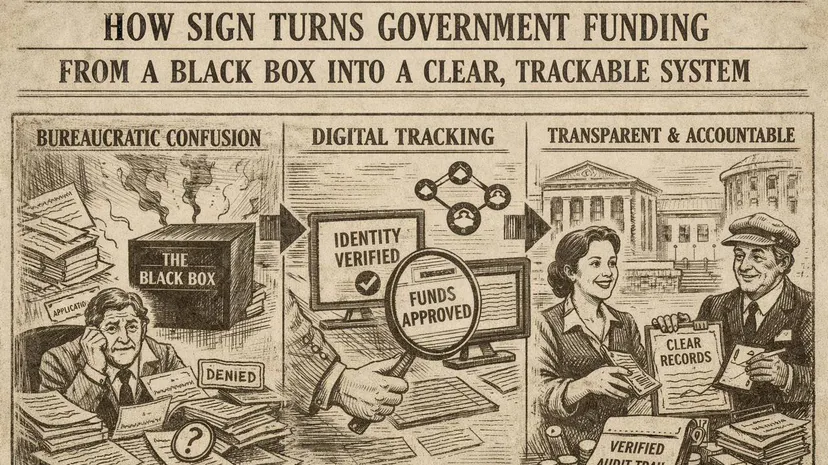
Sign flips that paradigm. Rules aren’t implied; they’re explicit. Eligibility criteria, allocation size, disbursement conditions—everything is defined upfront and executed deterministically. No discretionary filtering, no backchannel approvals. You either satisfy the logic, or you don’t. The system enforces outcomes, not intermediaries.
Capital deployment follows the same philosophy.
Instead of lump-sum transfers into untracked endpoints, funds become programmable. They can stream, unlock in tranches, or bind to milestone-based conditions. Capital turns into a state machine—responsive, conditional, and, if necessary, reversible. Misallocation or rule violations don’t require post-hoc intervention; they can be handled in-protocol.
But the real unlock is beneath the surface.
Every state transition leaves a cryptographic trail.
Not fragmented logs across institutions, but a unified, verifiable record of intent and execution. Allocation decisions come with provenance. Transfers carry destination proofs. Eligibility is backed by attestations, not assumptions.
So when audit time comes, there’s no need for reconstruction.
The system is the audit.
Who received what, when, and why—it’s all there, natively queryable and tamper-resistant.
This is where Sign stops looking like “just another crypto tool” and starts to resemble something closer to public infrastructure.
Because the problem space isn’t abstract. It’s the daily friction, leakage, and ambiguity in how real-world capital gets distributed.
Sign doesn’t try to fix that with trust.
It removes the need for it—replacing human discretion and fragmented workflows with transparent rules and self-verifying execution.